Introduction to National RDM Services
Federated Research Data Repository (FRDR)
What Is FRDR?
Agenda
What Is FRDR?
Why Use FRDR?
Getting Started: Account Setup and Data Deposit
After Deposit: Curation, Publication, and Preservation
What Is FRDR?
- A Canadian bilingual platform for sharing and preserving research data.
- Built through collaboration among research libraries, advanced research computing, and Canadian institutions.
- Funded by the Digital Research Alliance of Canada.
- Public access to find and download data.
- Deposit services reserved for eligible researchers, librarians, and designates at Tri-Agency eligible institutions.
- 1 TB of free storage by default for depositors.
- Additional storage can be requested through FRDR support.
Why Use FRDR?
Agenda
What Is FRDR?
Why Use FRDR?
Getting Started: Account Setup and Data Deposit
After Deposit: Curation, Publication, and Preservation
Why Use FRDR?
- A national, bilingual repository.
- Support for large-volume datasets (via Globus).
- Integrated curation and preservation services.
- Secure, geographically distributed storage.
- Advanced features:
- Collaboration with other account holders.
- Optional embargoes on data and metadata.
- Sharing for external peer review before publication.
- ORCID integration.
Service Statistics
Accounts
~500
Datasets
803
Volume
443 TB
Getting Started: Account Setup and Data Deposit
Agenda
What Is FRDR?
Why Use FRDR?
Getting Started: Account Setup and Data Deposit
After Deposit: Curation, Publication, and Preservation
Create an FRDR Account
- Go to frdr-dfdr.ca.
- Click Deposit data or Login.
- Sign in using:
- Your institution or Compute Canada.
- Your ORCID identifier.
- A Globus account with your institutional email.
Caution
Important: Always use the same sign-in method for your account.
Data Deposit: Steps
- Start: Select “Submit a new dataset”.
- Storage: Choose the collection (General) and add your collaborators.
- Metadata: Add required fields, then strengthen the record with funders, related identifiers, and dates.
- Access: Set an embargo or review access, if needed.
- Upload: Add your data and README file using the browser or Globus.
- Submission: Review the metadata and submit.
- Curation: The FRDR team reviews the deposit and confirms submission with a DOI.
After Deposit: Curation, Publication, and Preservation
Agenda
What Is FRDR?
Why Use FRDR?
Getting Started: Account Setup and Data Deposit
After Deposit: Curation, Publication, and Preservation
After Deposit
Curation Publication Preservation
Data Curation
Curation adds value by optimizing data for future discovery and reuse.
Process (based on CURATE(D)): - Verify and understand the documentation.
Request missing information or suggest practical changes.
Enhance metadata for discoverability.
Transform file formats and improve file organization for accessibility.
Assess data against the FAIR principles.
Tip
FRDR’s role: Review documentation, licensing, attribution, file naming, structure, formats, and potential sensitivities.Researchers are an essential part of this interactive process.
Data Publication
- Assignment of a unique DOI.
- Optional embargoes can support controlled release or external peer review.
- Data indexed for discovery (Lunaris, DataCite, Google Dataset Search, etc.).
- Data available for download directly or through Globus.
Remember to cite your data
Include your DOI in your publications, CV, and ORCID profile.
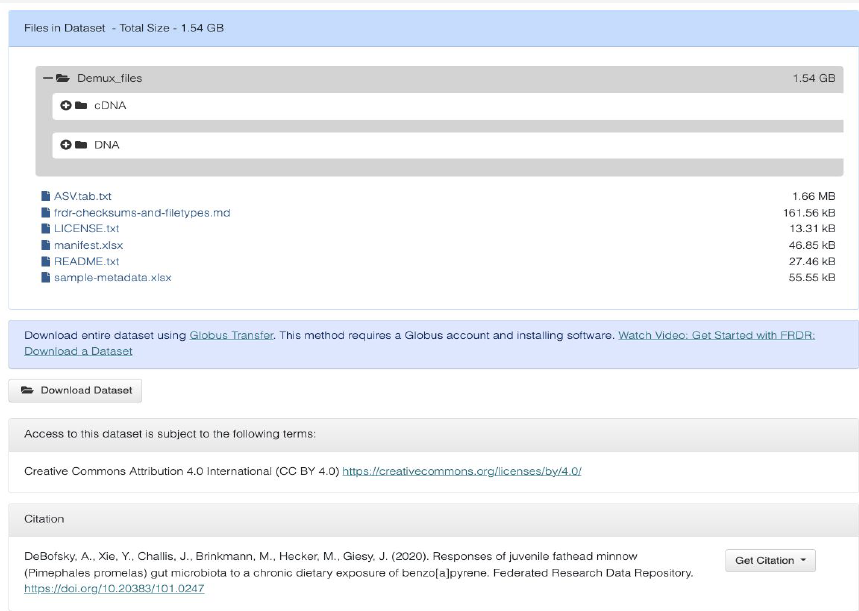
Dataset Landing Page
- Terms of use
- Download data
- LICENCE and checksums
- Browse files
- Recommended citation
After Publication
Your data remains yours
- You retain your rights and responsibilities after publication.
- You can reuse your dataset.
- You can create a new version when updates are needed.
- Good stewardship means changes remain transparent over time.
From Publication to Preservation
- Curation prepares data for understanding and reuse.
- Publication makes the dataset visible, citable, and accessible.
- Preservation focuses on keeping that dataset usable over time.
Note
The same choices that support curation today, such as documentation, file organization, and format selection, also support preservation tomorrow.
Resources and Support
Supporting Materials
Support Services
Contact us to confirm that your data is well prepared and can be shared effectively with the research community.
- Email: rdm-gdr@alliancecan.ca
- FRDR website

Introduction to National RDM Services - FRDR